An Anthropology of Marxism by Robinson Cedric J.; Quan H. L. T.; Gordon Avery F
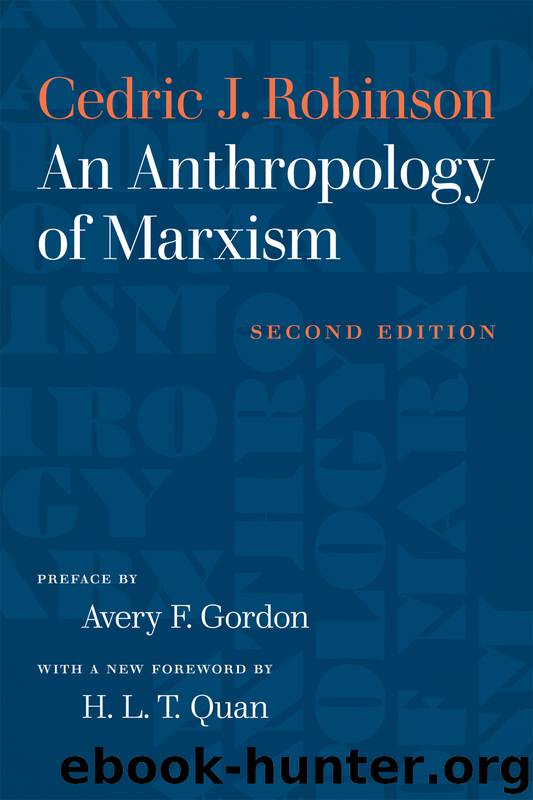
Author:Robinson, Cedric J.; Quan, H. L. T.; Gordon, Avery F.
Language: eng
Format: epub
Publisher: University of North Carolina Press
Published: 2001-01-15T00:00:00+00:00
Hegel and History
Hegel’s revulsion to capitalism and his attack on “modern industrial society” was to play no part in Marx’s critiques of Hegel. Indeed, by tracing the arguments in the Philosophy of Right to the abstract categories developed in Science of Logic and not to the earlier and explicitly political writings, Marx was able to dismiss Hegel as a mystical idealist.106 Subsequently, what remained of Hegelianism to be consciously and purposefully retrieved by Marxists was dialectical humanism, that is, Hegel’s philosophical construction of history. The fuller debt owed by Marxism remained hidden in the Hegelian machinery of History requisitioned by Marxian philosophy.
Hegel understood that a completed conceptualization of history required a philosophy of history which would supersede orthodox Christian eschatology. His new philosophy rested on the achievement of the consciousness of freedom, a more contemporary reading of the tradition of salvation. Notwithstanding, and in all likelihood quite unknown to Hegel, he was drawing upon the moral and metahistorical impulses of medieval heresy which had been woven into Protestantism. The renegades Joachim, Olivi, Fra Dolcino, and Ubertino had imagined a historical moment of egalitarian democracy, communitarianism, and perfect human knowledge, an age “beyond the fulfillment of prophecy in Jesus Christ.”107 And in Joachim could be discovered an expression of Hegel’s dialectic. Steven Ozment suggested: “Joachim believed that each age was already latent and evolving within the preceding age.”108 Like Joachim, Hegel came to believe that History is the persistent movement towards the achievement of the Absolute Spirit, the condition of perfect comprehension. “The structure of speculative thinking or Reason—the necessary dialectical self-movement of the ‘concept’ from the abstract, unmediated, and implicit to the concrete, fully mediated, and explicit—was thus identical with the structure of ultimate reality or ‘Being.’ … In The Phenomenology of the Spirit the comprehension of the identity of identity and nonidentity was revealed as the culmination of the whole process of human cultural development, the necessary outcome of the dialectical progression, the negation and ‘supersession’ of the shapes of human experience and consciousness.”109 It was not to humankind in general, however, that such perfection was destined. In Hegel’s apprehension of the historical dialectic, many human societies had failed, a few had not.
Hegel privileged Western civilization in his historical philosophy, citing the absence of Reason elsewhere. Those societies which had missed the interventions of world-historical individuals and the dialectic of the “universal principle” incorporate (e.g., China: “servile consciousness” and Africa: “land of childhood”) were doomed to arrested development or ahistoricality. For Hegel, ultimately, the historical development of the species-being was discoverable only in Europe.110 Hegel argued that the Rational State was the ultimate marker of species development. About the economy, the system of need, Hegel could only presume that its increasing sophistication was related only negatively to the human realization of totality. Marx’s materialism rearranged Hegel’s ethical system, asserting that man’s command of Nature was a precondition of emancipation. On that score, Marx like Hegel recognized the corruption and social disaggregation of industrial capitalism. But Marx would inherit Hegel’s Eurocentrism, too.
Download
This site does not store any files on its server. We only index and link to content provided by other sites. Please contact the content providers to delete copyright contents if any and email us, we'll remove relevant links or contents immediately.
| Anthropology | Archaeology |
| Philosophy | Politics & Government |
| Social Sciences | Sociology |
| Women's Studies |
The Secret History by Donna Tartt(19472)
The Social Justice Warrior Handbook by Lisa De Pasquale(12294)
Thirteen Reasons Why by Jay Asher(9122)
This Is How You Lose Her by Junot Diaz(7057)
Weapons of Math Destruction by Cathy O'Neil(6469)
Zero to One by Peter Thiel(5952)
Beartown by Fredrik Backman(5943)
The Myth of the Strong Leader by Archie Brown(5627)
The Fire Next Time by James Baldwin(5589)
How Democracies Die by Steven Levitsky & Daniel Ziblatt(5333)
Promise Me, Dad by Joe Biden(5230)
Stone's Rules by Roger Stone(5194)
A Higher Loyalty: Truth, Lies, and Leadership by James Comey(5090)
100 Deadly Skills by Clint Emerson(5023)
Rise and Kill First by Ronen Bergman(4906)
Secrecy World by Jake Bernstein(4889)
The David Icke Guide to the Global Conspiracy (and how to end it) by David Icke(4853)
The Doomsday Machine by Daniel Ellsberg(4624)
The Farm by Tom Rob Smith(4612)
